
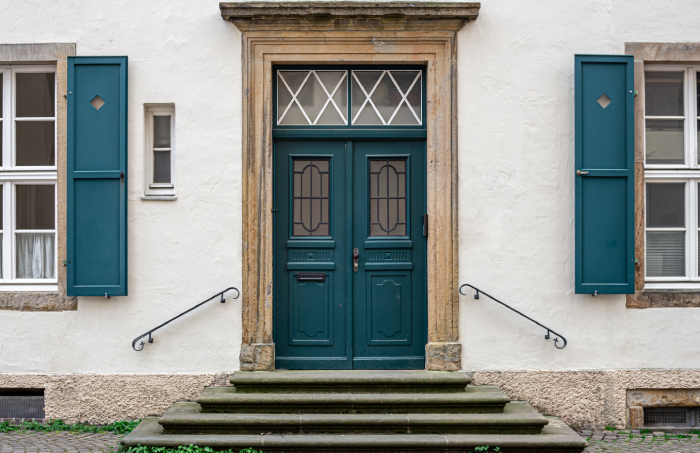
Your front door is the first thing people see. It sets the tone for your home’s exterior, affects security, impacts energy performance, and plays a real role in resale value. This guide covers every major front door style, how to match one to your home’s architecture, which materials hold up best in Southern California, what’s trending right now, and how hardware and color finish the look.
The Main Front Door Styles and What Defines Each One
Modern Front Doors
Modern front doors prioritize clean lines, minimal ornamentation, and large expanses of glass. The defining features are simple: flat panel construction, no decorative moulding, and hardware that disappears into the design rather than standing out from it.
Common characteristics:
- Single slab or flat panel construction
- Full-length or oversized glass panels
- Matte black, dark bronze, or natural wood finishes
- Concealed or minimal hardware
- Tall proportions, often floor to ceiling on pivot configurations
Modern doors suit mid-century modern homes in Los Feliz and Hollywood Hills, contemporary new builds in Malibu and the Santa Monica Mountains, and any home with a clean stucco or concrete exterior. They work particularly well with high-quality windows and doors in Los Angeles that share the same slim sightline aesthetic.
Traditional Front Doors
Traditional front doors are defined by raised panel construction, symmetrical design, and decorative detail. Four or six-panel configurations are the most common. They typically feature glass in the upper portion of the door, often paired with sidelights and a transom above the entry.
This style suits a wide range of home types and remains the most commonly specified door in established Los Angeles neighborhoods. Colonial Revival homes in Hancock Park, Windsor Square, and San Marino pair well with traditional paneled entries in painted wood or fiberglass.
Hardware for traditional doors leans toward brass, aged bronze, or brushed nickel with decorative ridges and curves. Bold colors like navy, forest green, and deep red perform well on traditional entries against light-colored facades.
Craftsman Front Doors
Craftsman doors reflect the Arts and Crafts movement’s emphasis on handmade quality, natural materials, and functional design. They tend to be wider rather than taller in proportion, with detailed woodwork, geometric glass inserts in the upper third of the door, and understated hardware.
Defining features:
- Glass panels concentrated in the upper section
- Vertical or diamond grille patterns in the glass
- Rich wood stains in warm browns like mocha or espresso
- Simple, functional hardware in black, distressed bronze, or distressed nickel
- Symmetrical sidelights flanking the entry
Craftsman bungalows in Pasadena, Highland Park, South Pasadena, and Angelino Heights are some of the best-preserved examples of this style in the region. A properly specified Craftsman door on one of these homes is an architectural asset that contributes directly to property value.
Spanish and Arched Front Doors
Spanish and arched doors are the natural choice for Southern California’s most distinctive residential style. Spanish Colonial Revival homes across Hancock Park, Beverly Grove, Miracle Mile, and Manhattan Beach call for entries that echo the home’s arched openings, stucco walls, and wrought iron details.
Arched doors come in several configurations:
- Standard arch: Rectangular body with a gentle curve at the top
- Full Spanish arch: A pronounced rounded top that mirrors the home’s window and doorway openings
- Gothic arch: A pointed top, less common in residential applications but distinctive on Tudor-influenced homes
Materials for Spanish-style entries lean toward solid wood, often knotty alder or walnut, with dark iron hardware. The combination of thick plank construction, dark metal, and richly textured wood surfaces suits the hacienda aesthetic that defines much of Southern California’s historic residential architecture.
Farmhouse Front Doors
Farmhouse doors blend traditional construction with a relaxed, unpretentious character. The classic version features a glass panel in the upper half and solid paneling or crossbuck detailing in the lower half. The modern farmhouse variation strips back some of the ornament and pairs simpler paneling with black hardware and clean lines.
Color plays a large role in farmhouse entries. Classic versions use rich earthtones, canvas white, or forest green. Modern farmhouse versions often go black with thin grilles. Both work well on ranch-style homes in the San Fernando Valley, Culver City, and Mar Vista, as well as on the newer farmhouse-influenced builds that have become common across the region.
Dutch and Stable Doors
Dutch doors split horizontally at the midpoint, allowing the top and bottom halves to operate independently. They function as a standard door when both halves are closed and locked, but can open the top half while keeping the bottom closed for ventilation, light, or to keep children and pets inside.
This style has seen a real resurgence in Southern California over the past few years, particularly on cottage-style homes, bungalows, and informal residential entries. The look is charming without being fussy, and the functional split design suits the indoor-outdoor lifestyle that LA homes are built around.
Double Front Doors
Double doors make a strong architectural statement and work best on homes with wide, symmetrical entries. They expand the opening significantly, which improves accessibility and allows more natural light into the foyer. Mediterranean Revival homes in Manhattan Beach and Redondo Beach, large traditional homes, and luxury new construction all pair well with double entries.
The tradeoff is cost and weatherproofing. Two doors require more precise installation to seal correctly at the meeting point, and hardware costs approximately double a single door. For homes where the entry width and architectural scale support it, the visual impact justifies both.
Pivot Front Doors
Pivot doors rotate on a central or offset vertical axis rather than hinging at the side. They open in both directions, create a dramatic entry experience, and are one of the most-requested styles in contemporary luxury home design right now.
Full-height pivot doors in steel, aluminum, or wood are appearing on high-end builds across Bel Air, Pacific Palisades, and Malibu. They suit architecture where the door is meant to be a design focal point rather than a background element. Lead times are longer and installation requires more structural preparation than standard hinged doors, so plan early if this is your specification.
Front Door Materials: Which One Is Right for Your Home
Material choice affects how your door looks, how long it lasts, how much maintenance it requires, and how well it performs in Southern California’s specific climate conditions.
| Material | Lifespan | Maintenance | Best Style Match | SoCal Consideration |
| Wood | 10 to 30 years | High | Craftsman, Spanish, Traditional, Farmhouse | UV and heat degrades finish faster than in milder climates |
| Fiberglass | 25 to 40 years | Low | Any style | Resists warping and UV; best all-around for SoCal |
| Steel | 20 to 35 years | Low to moderate | Modern, Farmhouse, Traditional | Can dent; coastal salt air requires protective coating |
| Aluminum | 25 to 40 years | Low | Modern, Pivot, Contemporary | Thermally broken versions required for energy performance |
Wood
Wood delivers warmth, natural grain, and the most authentic look for Craftsman, Spanish Colonial, and traditional entries. It’s highly customizable in size, profile, and finish. The tradeoff is maintenance. In Southern California’s UV-intense climate, an unprotected wood door can fade, crack, or warp faster than it would in cooler regions. Annual refinishing or resealing keeps wood performing well, but it’s a real commitment over the life of the door.
Hardwoods like knotty alder, walnut, mahogany, and white oak are the most common choices. Each has a distinct grain character that interacts differently with stain.
Fiberglass
Fiberglass is the most practical material for Southern California homes across the widest range of styles. It resists warping from heat cycling, holds up against UV exposure without the maintenance commitment of wood, and can be manufactured to convincingly replicate wood grain. Most fiberglass doors carry strong manufacturer warranties covering finish adhesion and structural performance.
For homeowners who want the look of wood without the upkeep, a fiberglass door with a quality wood-grain finish is the answer. Brands like Andersen and Marvin offer fiberglass entry doors in configurations that suit everything from Craftsman bungalows to contemporary builds.
Steel
Steel doors offer the highest security rating of any material and are an excellent choice for modern and farmhouse styles where clean, flat-panel construction is the design goal. They’re factory-finished and require very little maintenance beyond periodic cleaning.
The main limitation is that steel dents on impact and conducts heat unless insulated. For coastal properties, a quality powder-coat finish is non-negotiable — bare or inadequately finished steel corrodes in salt air environments.
Aluminum
Thermally broken aluminum is the premium material for modern and contemporary entries, particularly on luxury builds where slim profiles and large-format glass are part of the design. Standard aluminum conducts heat readily, which works against energy performance in a hot climate. A thermally broken frame inserts a non-conductive barrier between the interior and exterior sections, resolving that problem.
Aluminum’s strength allows for larger configurations than wood or fiberglass at comparable weight, which is why pivot doors, full-height entries, and oversized double doors are almost always specified in aluminum. Our door installation services cover the full range of aluminum entry door systems from the brands we carry.
Glass Options for Front Doors
Glass transforms an entry. It brings light into the foyer, adds visual interest, and changes the character of the door entirely. Here are the main configurations:
Full glass panels run the height of the door and are most common on modern and contemporary entries. They maximize light but reduce privacy. Frosted, textured, or tinted glass addresses privacy concerns while preserving the look.
Upper third glass is the classic position for Craftsman and farmhouse entries. It brings in light without exposing the interior, and the smaller glass area is easier to pair with decorative grilles.
Sidelights are fixed glass panels installed on one or both sides of the door. They dramatically increase the light in an entry foyer without changing the door itself. Sidelights are standard on traditional and colonial entries and increasingly common on modern entries as narrow fixed panels.
Transoms sit above the door and add light and architectural height to an entry. They’re associated with traditional and historic entries but appear on contemporary builds as well, particularly when ceiling height allows for the additional visual element.
Decorative glass options include:
- Clear: maximum light, no privacy
- Frosted or sandblasted: diffused light, good privacy
- Textured: privacy with visual interest
- Etched or art glass: Craftsman and period entries, custom designs
- Tinted: reduces solar heat gain, relevant for west-facing entries in inland LA
For south and west-facing entries in Southern California’s inland climate zones, a Low-E coating on any glass panel reduces solar heat gain without affecting appearance. It’s worth specifying on any door that takes direct afternoon sun.
Trending Front Door Styles in 2025 and 2026
These are the styles and details generating real demand right now in the Los Angeles market.
Pivot doors are the most-requested upgrade on luxury new construction and high-end renovations. Full-height steel or aluminum pivot entries on contemporary homes have moved from architectural exception to expected feature on builds above a certain price point.
Black finishes continue to dominate. Matte black on a modern or farmhouse door is the most-specified color combination in the region right now. It reads as clean and intentional against white, gray, or warm stucco exteriors.
Mixed materials pair steel with wood, or painted aluminum with natural wood panels, to create contrast within the door itself. The approach adds depth without additional trim or decorative detail.
Arched entries are gaining ground again, particularly on new construction that draws from Mediterranean and Spanish Colonial precedents. An arched opening with a custom wood door is one of the most consistent requests on high-end residential projects in Hancock Park, Brentwood, and Pacific Palisades.
Bold color on traditional entries has been building for several years and shows no sign of slowing. Deep ruby red, navy, and forest green are all performing well on traditional and farmhouse doors against neutral-colored facades. The door becomes the intentional focal point of the exterior.
Matching Your Front Door to Your Home’s Architecture
This is the question most guides skip. Here’s a direct reference by home type.
| LA Home Style | Neighborhoods | Recommended Door Style | Recommended Material |
| Spanish Colonial Revival | Hancock Park, Beverly Grove, Windsor Square | Arched, plank wood, iron hardware | Solid wood, knotty alder |
| Craftsman Bungalow | Pasadena, Highland Park, South Pasadena | Craftsman with upper glass and grilles | Wood or high-quality fiberglass |
| Mid-Century Modern | Los Feliz, Hollywood Hills, Encino | Modern flat panel, pivot, minimal hardware | Aluminum, fiberglass |
| Mediterranean Revival | Manhattan Beach, Redondo Beach, San Pedro | Double entry, arched, decorative glass | Wood, fiberglass |
| Contemporary / New Build | Malibu, Pacific Palisades, Bel Air | Pivot, full glass panel, modern slab | Aluminum, steel |
| Ranch Style | San Fernando Valley, Culver City, Mar Vista | Farmhouse, traditional panel, Dutch | Fiberglass, wood |
| Victorian | Angelino Heights, Carroll Avenue | Traditional paneled, decorative glass, ornate hardware | Wood, fiberglass |
The table above is a starting point, not a rule. Many Los Angeles homes blend architectural details from multiple styles, and the right door often works across categories. If you’re unsure, the safest approach is to match the door’s panel profile and material to the dominant material on your home’s exterior, then let hardware and color do the style-specific work.
Hardware and Color: The Details That Finish the Look
Hardware and color are where a door goes from functional to finished. Both decisions are easier to make once you’ve locked in the style and material.
Hardware finishes by door style:
| Door Style | Recommended Hardware Finish |
| Modern / Contemporary | Matte black, brushed nickel, concealed |
| Craftsman | Distressed bronze, matte black, oil-rubbed bronze |
| Traditional | Polished brass, aged bronze, brushed nickel |
| Spanish / Arched | Dark iron, oil-rubbed bronze, wrought iron |
| Farmhouse | Matte black, aged bronze, simple lever handles |
| Pivot | Oversized lever in black or brushed metal |
Paint vs. stain: Painted doors give you more color control and are easier to refresh. Stained doors preserve the natural grain character of wood and age distinctively. On fiberglass doors, high-quality stain finishes convincingly replicate wood grain at lower maintenance cost. If your home’s exterior uses natural wood detailing, a stained door creates continuity. If the exterior is primarily painted surfaces, a painted door in a contrasting color tends to read better.
Popular door colors for Los Angeles homes:
- Matte black: modern, farmhouse, contemporary
- Forest green: traditional, farmhouse, Craftsman
- Navy blue: traditional, colonial, classic neighborhoods
- Deep red: traditional entries on warm-toned facades
- Natural wood stain: Craftsman, Spanish Colonial, Mediterranean
- White or canvas: farmhouse, clean modern, coastal
Hardware finish and door color should work together, not compete. A matte black door with polished brass hardware creates conflict. A navy door with aged bronze hardware creates continuity. Match the undertones in both before committing.
Frequently Asked Questions About Front Door Styles
Which Front Door Material Holds Up Best in Southern California?
Fiberglass is the most practical choice for most LA homes. It resists warping from heat cycling, holds up against UV exposure without the maintenance commitment of wood, and comes in configurations that suit almost every architectural style. For luxury builds and contemporary entries where design matters as much as performance, thermally broken aluminum is the premium choice. Wood is the right call when authenticity is the priority and the owner is committed to regular maintenance.
Do Front Doors with Glass Panels Compromise Security?
Not significantly, with the right glass specification. Laminated glass, which bonds two layers with an interlayer that holds the glass together on impact, resists forced entry far better than standard glass. Tempered glass is stronger than standard glass but shatters on failure. For any entry door with glass in or adjacent to the lock zone, laminated glass is the right specification.
Is a Pivot Door Practical for a Standard Home?
A pivot door works on any home with sufficient structural support at the pivot point and an appropriately scaled entry. It’s not exclusively a luxury product, though it’s most commonly specified on contemporary high-end builds. The main practical considerations are ceiling height, floor clearance for the swing arc, and rough opening width. A structural assessment is part of any proper pivot door installation.
Should I Replace All Exterior Doors at the Same Time?
Not necessarily. Front door replacement is almost always a standalone project. If your side entry, garage, or patio doors are performing well, there’s no technical reason to replace them simultaneously. That said, matching finish and hardware across all exterior doors creates visual coherence that’s worth considering if multiple doors are approaching end of life at the same time.
How Much Does a New Front Door Cost in Los Angeles?
Costs vary widely by material, style, and configuration. A standard fiberglass entry door installed runs $1,500 to $4,000 for most residential projects. A wood door in a custom configuration runs $3,000 to $8,000 installed. Full-height aluminum or steel pivot doors in luxury configurations start around $8,000 and go up significantly from there. The best way to get an accurate number for your specific project is an in-home assessment from a licensed installer.
At Fusion Windows and Doors, we carry entry door systems from Andersen, Marvin, Fleetwood, and other brands across the full range of styles covered in this guide. Our team serves homeowners throughout Los Angeles and the surrounding communities. If you’re ready to choose a new front door and want expert guidance on what suits your home’s architecture, get a free quote and we’ll walk you through the options in person.