
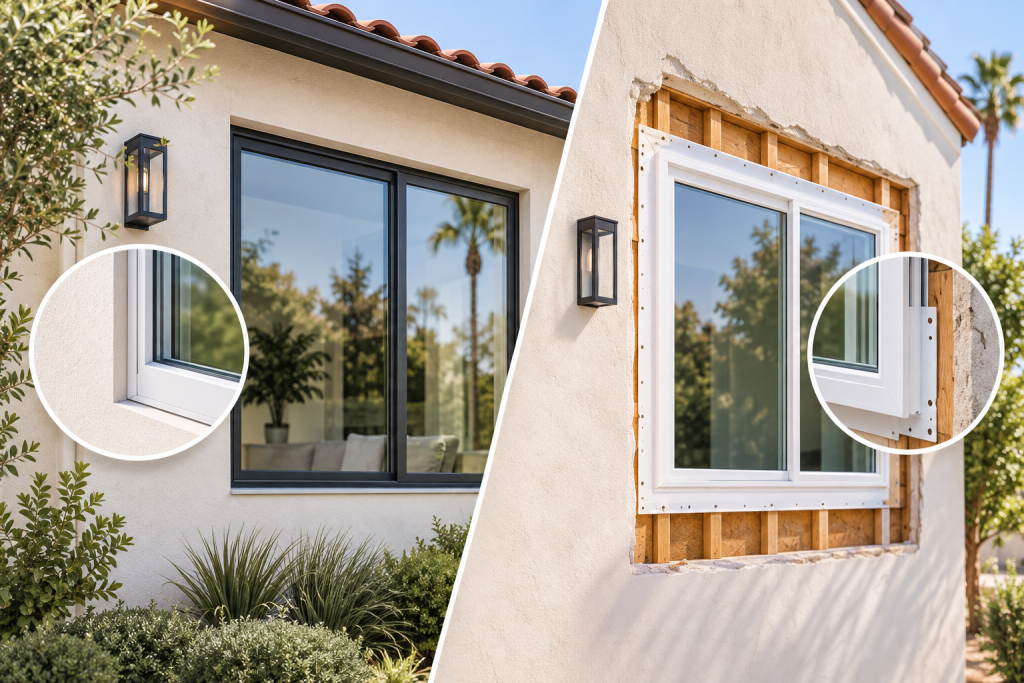
Replacement windows fit into your current window opening, so your walls and stucco stay untouched. New construction windows nail straight to the wall frame, which means the outside wall around each window has to be opened up.
This guide shows you the main differences, what each option costs, and how to pick the right one for your home.
The Key Differences Between Replacement and New Construction Windows
Once installed, both types can look the same. The real differences are how they attach, how much of your wall gets opened, and how much you pay for labor.
Nailing Fins and Frame Design
New construction windows have a nailing fin. This is a thin strip around the outside of the frame that gets nailed to your wall studs.
Replacement windows usually don’t have a nailing fin. They slide into your existing opening and are held in place with screws.
Installation Scope: What Gets Removed
New construction: Your installer removes the siding or stucco around each window. This gives them access to the wall frame so they can nail and seal the new window.
Replacement: Your installer leaves the outside wall alone. They take out the old window and fit the new one into the same opening.
Glass Area and Window Size
New construction windows use the full opening, so you keep all your glass. You can also make the window bigger, smaller, or a new shape.
Some replacement windows sit inside your old frame. This can shrink your glass by about 1 to 2 inches on each side.
Cost and Labor
The windows themselves often cost about the same. The difference is labor.
New construction takes much longer because the crew has to open the wall and then repair it. Replacement windows go in faster, so you pay less for labor.
Replacement vs. New Construction Windows at a Glance
| Feature | Replacement Windows | New Construction Windows |
| Best for | Homes with solid, dry frames | New homes, additions, and damaged frames |
| Nailing fin | Usually no | Yes |
| Siding or stucco removal | No | Yes, around each window |
| Glass size | May shrink a little | Full size, and you can make it bigger |
| Weather seal | Good if the old frame is solid | The tightest seal possible |
| Time per window | About 1 to 2 hours | About 4 to 8 hours, plus wall repair |
| Total cost | Lower | Higher |
| Energy savings | Same with the same glass | Same with the same glass |
| Can change size or shape | No | Yes |
Good to know: The install type doesn’t change how well a window insulates. The glass and frame do. You can learn more in the Department of Energy’s guide on whether to update or replace your windows.
The Three Types of Window Installation
You’ll often hear three terms from installers. Here’s what each one means.
Insert (Pocket) Replacement
Your installer removes only the moving parts of the old window. The old frame stays, and the new window fits inside it.
It’s the fastest and cheapest option. Your trim and walls stay untouched.
Full-Frame Replacement
Your installer removes the whole old window, frame and all. The new window goes into the bare opening.
The trim comes off, but your siding or stucco usually stays in place.
New Construction Installation
Your installer cuts back the siding or stucco around the window. The new window is nailed to the wall frame and sealed against water.
Then the crew patches and paints the outside wall.
| Install Type | What Gets Removed | Cost | Best For |
| Insert | Old moving parts only | Low | Solid frames and tight budgets |
| Full-frame | The whole old window and trim | Medium | Worn frames in a solid wall |
| New construction | Window, trim, and the wall around it | High | New homes, rot, and size changes |
When to Use Replacement Windows
Replacement windows are the right pick for most homes. Choose them when:
- Your frames are in good shape. There’s no rot, soft wood, or water stains.
- You like your current window sizes. You don’t want to change any openings.
- You want to save money. You skip the cost of wall and stucco repair.
- You don’t want to touch your stucco. New stucco patches can be hard to match.
- You want it done fast. Most homes can be finished in one or two days.
Not sure your windows need replacing yet? Our guide on when to replace your windows lists the warning signs.
When to Use New Construction Windows
New construction windows are worth the extra cost when:
- You’re building a new home or addition. New walls need windows that nail to the frame.
- Your frames have rot or water damage. Opening the wall lets your crew fix the damage first.
- You want a bigger or different window. Changing an opening means rebuilding part of the wall.
- You’re already remodeling. If the stucco or siding is coming off anyway, the extra cost is small.
- Your windows have leaked for years. Water may have damaged the wall, and you need to see it to fix it.
How to Decide: Questions to Ask About Your Home
Answer these four questions, and the right choice usually becomes clear.
What Condition Are Your Frames and Siding In?
Press on the wood around your windows with a screwdriver. If it feels soft or crumbles, you likely have rot, and new construction is the safer choice.
If the frames feel solid and dry, replacement windows will work.
Do You Want to Change the Window Size or Shape?
If you want a bigger window, a new shape, or a window where there isn’t one now, you need new construction.
If you’re keeping the same sizes, replacement windows will do the job.
Is Your Home Stucco, Siding, or Brick?
Stucco and brick are costly to cut and patch, so replacement windows usually make more sense.
Siding is easier to remove and put back. That makes new construction less of a hassle on sided homes.
Are You Already Remodeling?
If your walls are already open for a remodel, go with new construction. You’ll get the best seal for little extra work.
| Your Situation | Best Choice |
| Solid frames, same sizes, stucco home | Replacement (insert or retrofit) |
| Worn frames but a solid wall | Full-frame replacement |
| Rot or water damage in the wall | New construction |
| Making windows bigger or adding new ones | New construction |
| New home or addition | New construction |
| Full exterior remodel already planned | New construction |
Replacement vs. New Construction Window Costs
The tables below show typical prices for Los Angeles homes. Your final price depends on the brand, size, glass, and condition of your walls.
Window Unit Cost by Type
| Window Type | Min Cost (per window) | Max Cost (per window) |
| Replacement window (vinyl) | $400 | $900 |
| Replacement window (fiberglass or wood) | $700 | $1,800 |
| New construction window (vinyl) | $350 | $850 |
| New construction window (fiberglass or wood) | $650 | $1,700 |
Installation Labor Cost by Type
| Install Type | Min Cost (labor per window) | Max Cost (labor per window) |
| Insert replacement | $150 | $400 |
| Retrofit (stucco homes) | $200 | $450 |
| Full-frame replacement | $300 | $700 |
| New construction | $500 | $1,200 |
Total Installed Cost by Frame Material
| Frame Material | Replacement: Min | Replacement: Max | New Construction: Min | New Construction: Max |
| Vinyl | $600 | $1,300 | $900 | $2,000 |
| Fiberglass | $900 | $2,000 | $1,300 | $2,800 |
| Wood or clad wood | $1,000 | $2,500 | $1,500 | $3,500 |
| Aluminum | $800 | $1,800 | $1,200 | $2,700 |
Fiberglass costs more than vinyl, but it lasts longer in heat. Our fiberglass vs. vinyl windows guide compares the two in detail.
Hidden Costs to Plan For
| Hidden Cost | Min Cost | Max Cost | When It Applies |
| Stucco cut and patch | $300 | $900 per window | New construction on stucco homes |
| Siding removal and repair | $150 | $500 per window | New construction on sided homes |
| Exterior paint touch-up | $100 | $400 per window | After stucco or siding repair |
| Interior trim replacement | $100 | $350 per window | Full-frame and new construction |
| Rot or water damage repair | $250 | $1,500 per window | When damage is found |
| Permit | $150 | $600 | Most full-frame and new construction jobs |
| Old window disposal | $25 | $75 per window | Most jobs (often included) |
Southern California Factors That Change the Answer
Most guides online are written for homes with wood siding in cold climates. Homes in Los Angeles face different issues.
Stucco Homes and Retrofit Frames
Most LA homes have stucco. Cutting stucco is messy, and patches rarely match perfectly.
That’s why most LA window jobs use retrofit windows. These have a flat outer lip (often called a Z-bar) that covers the old frame from the outside. Your stucco stays untouched, and the result looks clean.
Fire Rebuilds in the Palisades, Malibu, and Altadena
Homes rebuilt after a fire need new construction windows. The walls are new, so the windows nail straight to the frame.
These areas also have special fire rules for glass. Windows usually need dual-pane glass with at least one tempered pane. The Office of the State Fire Marshal explains these rules.
Older Homes With Water Damage or Earthquake Shifts
Over decades, small earthquakes can twist window frames out of square. Old leaks can also rot the wood inside the wall.
If your windows stick, leak, or have gaps you can see, open the wall and check. New construction lets your crew fix the problem instead of hiding it. Water near your windows can also come from inside the house. Our guide to condensation on windows explains how to tell the difference.
Title 24 Rules for Replacement Windows
California’s energy code, Title 24, applies to both types. Most new windows must have a U-factor of 0.30 or lower and an SHGC of 0.23 or lower.
You can read the rules on the California Energy Commission’s building standards page. Your installer should confirm every window meets them.
Brands That Offer Both Options
All the major brands we install make both replacement and new construction versions of their windows.
- Milgard windows: Offers retrofit frames made for stucco homes. Most series come with a lifetime warranty on parts and labor.
- Andersen windows: Offers insert and full-frame options across its main series. Our Milgard vs. Andersen windows comparison breaks down the differences.
- Marvin windows: Offers insert kits and full-frame units in fiberglass and wood.
- Fleetwood windows: Mostly used in new construction and major remodels with large glass openings.
Get Expert Advice on Your Windows
Fusion Windows and Doors has installed windows and doors in Los Angeles for more than 20 years. We’ll check your frames and walls, then tell you honestly whether replacement or new construction is right for your home. Get a free quote to get started.