
Most people learn the parts of a window at a bad moment. A sash stops staying up. Fog appears between the panes and won’t wipe off. Water shows up on the drywall under the sill after the first real storm of the year. Then a quote arrives with words like “IGU,” “check rail,” and “nailing fin,” and none of it means anything.
This guide covers every part of a window: the frame, the sash, the glass, the hardware, the weatherproofing, and the trim. It also covers the parts that never make it into these glossaries, like weep holes, sill pans, and the difference between a rough opening and a window size. At the end there’s a symptom chart that works backward from what your window is doing to the part causing it.
If you already have the vocabulary and you’re trying to decide what to buy, start with our guide to window types and styles instead. Come back here when a quote stops making sense. And if you’re working through doors on the same project, we have a companion guide to the parts of a door.
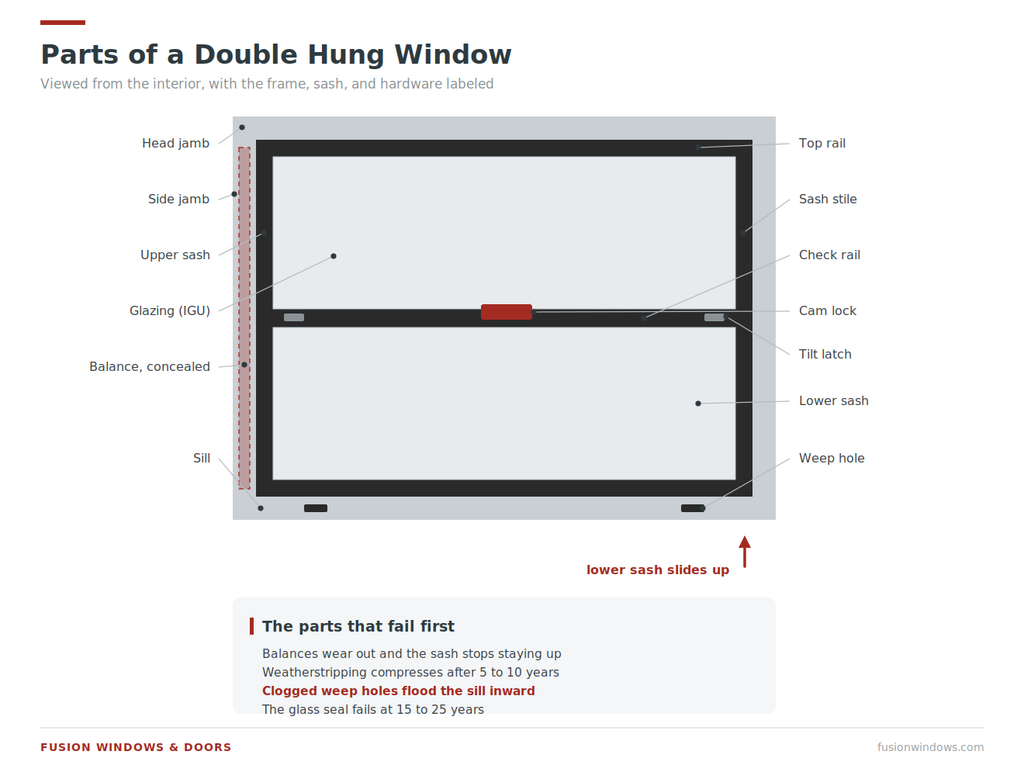
Quick Reference: Parts of a Window
| Part | Where it is | What it does |
| Head jamb | Top of the frame, horizontal | Caps the frame and carries the load above |
| Side jambs | Both vertical sides of the frame | Support the sash and hold the hardware |
| Sill | Bottom member of the frame | Seals the base of the opening and sheds water |
| Sash | The part holding the glass | Moves, or sits fixed, inside the frame |
| Stiles | Vertical edges of the sash | Carry the lock, hinges, or balance connection |
| Rails | Horizontal edges of the sash | Tie the stiles together |
| Check rail | Where two sashes meet | Seals the middle joint and holds the lock |
| Glazing | The glass itself | Insulates, blocks UV, and lets in light |
| Glass spacer | Between the panes | Holds the panes apart and seals the gas in |
| Balance | Inside the side jambs | Counterweights the sash on hung windows |
| Operator | On the frame, casement and awning | Cranks the sash open and closed |
| Cam lock | On the check rail | Pulls the two sashes tight together |
| Weatherstripping | Around the sash perimeter | Seals the gap when the window is closed |
| Weep holes | Bottom of the sill or track | Drain water back out of the frame |
| Screen | Outside or inside the sash | Blocks insects, passes air and light |
| Nailing fin | Around the frame perimeter | Fastens the window to the wall sheathing |
| Brickmould | Exterior wall, around the frame | Covers the gap on the outside |
| Casing | Interior wall, around the frame | Covers the gap on the inside |
| Jamb extension | Between frame and interior wall | Bridges the depth of the wall |
| Mullion | Between two joined windows | The seam where two units meet |
| Grilles / SDLs | On or between the panes | Create the look of divided panes |
The Window Frame
The frame is the fixed part. It gets set into the rough opening, shimmed square, fastened to the framing, and everything else hangs off it. When a window has a real problem, the frame is usually where it started.
Head Jamb
The horizontal member at the top of the frame. On an exterior wall, this is the piece the head flashing tucks behind. If you see staining at the top corners of a window from the inside, the head jamb detail is the first thing a good installer will look at, not the glass.
Side Jambs
The two vertical members. On hung windows they house the balances. On casements they carry the hinge track. On sliders they hold the keeper the latch hooks into.
Side jambs have to stay parallel. A frame that gets racked out of square during installation, usually from over-driven fasteners or missing shims, is the reason a brand new window won’t lock properly. That is an installation failure, not a manufacturing defect, and it shows up within the first year.
Sill
The bottom member of the frame. It’s sloped toward the exterior so water runs off instead of standing.
Sills are the most neglected part of any window. In Los Angeles, failures here rarely come from constant rain. They come from a handful of hard storms hitting a sill that was never flashed correctly, plus sprinkler overspray hitting the same spot several times a week for years.
Sill vs. Stool vs. Apron
Three different pieces, and people mix them up constantly.
- Sill: The sloped exterior bottom member of the frame. Structural, part of the window.
- Stool: The flat interior ledge you set a plant on. Trim, not part of the window.
- Apron: The trim board directly under the stool.
When someone says “my window sill is rotting” and points to the inside, they almost always mean the stool. Different repair, different price.
Jamb Extension
Walls come in different thicknesses. Window frames come in standard depths. The jamb extension covers the gap between the two, running from the window frame to the plane of the finished interior wall.
These can be factory-applied or built on site. In some remodels, drywall is returned directly into the window frame instead, which eliminates the extension entirely and gives a cleaner, more modern reveal. It also gives you no wood to nail trim to later, so it’s a decision to make before drywall, not after.
Mullion
When two or more window units are joined into one assembly, the seam between them is the mullion. A picture window flanked by two casements is three units and two mullions.
Mullions are a structural detail worth asking about. On a wide assembly, the mullion carries load, and a poorly specified one will deflect under wind pressure and break the seal at the joint. Any large opening deserves a factory-mulled assembly rather than three units field-joined on site.
Rough Opening
The framed hole in the wall, not the window size. It’s typically about half an inch wider and half an inch taller than the window unit, which leaves room to shim the frame plumb and square.
This trips up most homeowners who try to measure their own windows. Measuring the visible glass gives you the daylight opening. Measuring between the jambs gives you neither the unit size nor the rough opening. If you’re pricing a project, our window replacement cost guide explains how sizing affects what you’ll pay.
Nailing Fin
A thin flange, usually vinyl or aluminum, running around the outside perimeter of the frame. It fastens the window to the wall sheathing and integrates with the flashing and the weather resistant barrier to keep water out of the wall.
Fins matter for one practical reason: a window with a nailing fin has to go in from the outside, which means removing siding or stucco. Windows without fins, called block frame or retrofit windows, install into the existing frame from inside or outside without disturbing the wall finish. That difference drives a big share of the labor cost on a replacement job.
The Sash
The sash is the assembly that holds the glass. On operating windows it moves. On fixed windows it sits still, or doesn’t exist at all.
Stiles
The vertical members on both sides of the sash. On a casement, one stile carries the hinges and the other carries the lock. On a hung window, both stiles ride in the jamb channels.
Stile width is a design decision with real consequences. Narrow stiles give you more glass and a cleaner sightline, which is why steel and aluminum systems look the way they do. Wide stiles give you more material to hold hardware and more thermal mass. If you’re comparing a Fleetwood or Euroline aluminum and steel system against a vinyl window, sightline width is one of the biggest visible differences.
Rails
The horizontal members of the sash. Top rail, bottom rail, and on hung windows, the check rail.
Check Rail (Meeting Rail)
On a double hung or single hung window, the check rail is where the bottom of the upper sash meets the top of the lower sash. It carries the lock and the primary weatherstripping for that joint.
The check rail is the weak point on any hung window. It’s the one seam that isn’t compressed by the frame, so it relies entirely on the lock pulling the two sashes together. A hung window that whistles in wind almost always has a check rail issue, not a glass issue.
Fixed Sash vs. Direct Glaze
Some non-operating windows have a sash that simply never moves. Others skip the sash and set the glass directly into the frame, which is called direct glaze or direct set.
Direct glaze gives you a noticeably larger daylight opening and a thinner sightline, because there are no stiles and rails eating into the view. That’s why most modern picture windows are direct glazed. The tradeoff is that the glass cannot be removed and reinstalled without pulling the unit, so a seal failure means a bigger job.
Daylight Opening (DLO)
The visible glass area, not counting the sash and frame. This is the number that determines how much light and view you actually get, and it’s why two windows with identical unit sizes can feel completely different in a room.
Glass and Glazing
Glazing
Glazing just means the glass. In any modern window it means an insulated glass unit, not a single sheet.
Insulated Glass Unit (IGU)
Two or three panes sealed together with a gas fill between them. This is the part of the window that does the actual thermal work, and it’s also the part with a finite lifespan. The seal around the perimeter typically lasts 15 to 25 years depending on sun exposure.
When that seal fails, moisture gets between the panes and you get permanent fog that no cleaning will remove. Our guide on how long windows last breaks this down by material and exposure.
Glass Spacer
The strip around the perimeter of the IGU holding the panes apart. Older windows used aluminum, which conducts heat straight through the edge of the unit and causes condensation at the bottom of the glass in cold weather. Warm edge spacers made of foam or structural silicone cut that transfer significantly.
Spacer type is a spec worth asking about because it doesn’t show up in the U-factor headline number but affects the actual edge performance.
Argon and Krypton
The gas between the panes. Argon is standard and cheap. Krypton performs better in narrow cavities but costs considerably more, so it mostly shows up in triple pane assemblies where the individual gaps are tight.
Low-E Coating
A microscopically thin metallic coating on one glass surface that reflects long-wave heat while passing visible light. This is the single most important glass spec in Southern California.
A west-facing window here takes direct afternoon sun for hours in summer. The right Low-E coating cuts solar heat gain without darkening the view or tinting the glass, and it’s central to meeting California’s Title 24 requirements. We go deeper on which coatings to specify in our guide to energy efficient windows for hot climates.
Tempered and Laminated Glass
Tempered glass is heat-treated so it breaks into small dull pieces instead of shards. Code requires it in specific locations: within 24 inches of a door, below 18 inches from the floor, in bathrooms near tubs and showers, and near stairs.
Laminated glass has a plastic interlayer that holds the pane together when struck. It’s the better choice for security, for sound reduction on a busy street, and for any ground-floor window near a lock. It costs more and it’s worth it on the specific openings where it matters.
Grilles, SDLs, and Muntins
Three terms for the same visual effect, built three different ways.
- Muntins are true structural dividers holding individual small panes. Original to historic windows. Least energy efficient, most authentic.
- Simulated divided lites (SDLs) are bars bonded to both glass surfaces, usually with an internal spacer bar so the shadow line reads correctly. The most convincing modern option.
- Grilles between the glass (GBG) sit sealed inside the IGU. Easiest to clean, flattest looking.
- Removable grilles clip onto the interior surface and pop off for cleaning.
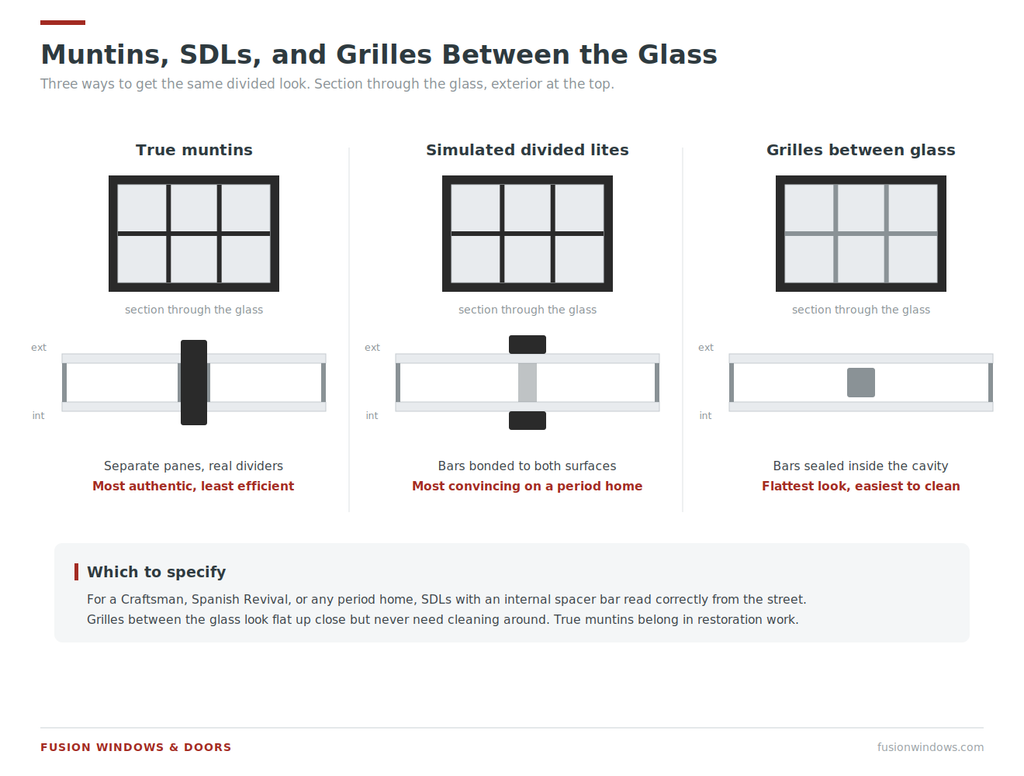
If you’re matching a Craftsman in Pasadena or a Spanish Revival in Los Feliz, SDLs with a spacer bar are usually the right call. GBGs read as flat from the street and rarely convince on a period home.
Window Hardware
Hardware varies more by window type than any other category, so this section is organized by what you actually have.
Balances (Hung Windows)
The mechanism inside the side jambs that counterweights the sash so it lifts easily and stays where you put it. Old windows used a lead weight on a cord over a pulley. Modern double hung windows use block and tackle or spiral balances, with spring tension instead of weights.
A sash that slams shut or won’t stay up has a failed balance. This is a repairable part on most windows, not a reason to replace the unit, though on a vinyl window that’s already 25 years old the math usually favors replacement.
Cam Lock and Keeper
The rotating lock on the check rail of a hung window. Turning it draws the two sashes tight against each other, which is what actually seals the joint. The keeper is the stationary half it engages.
A cam lock that’s hard to turn usually means the sashes aren’t aligned, which means the frame has shifted. Forcing it bends the keeper and makes the problem permanent.
Operator and Operating Arm (Casement and Awning)
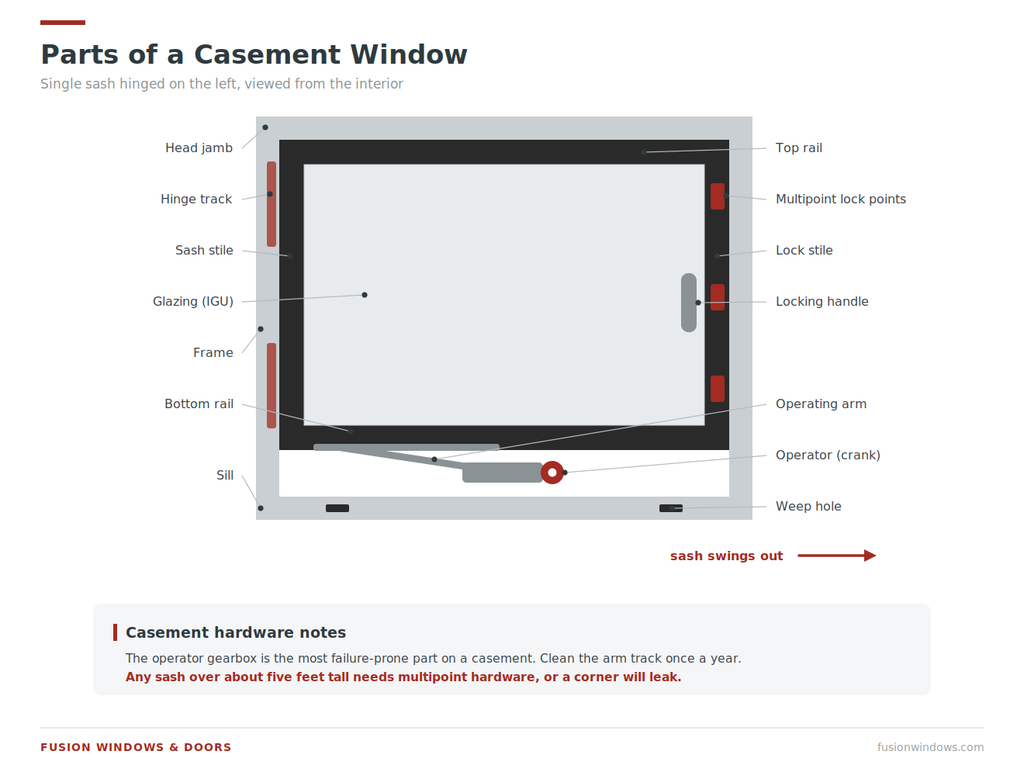
The crank handle and the folding arm assembly that pushes the sash open. The operator contains a gearbox. The arm carries the load.
Crank hardware is the most failure-prone part on a casement window. Gearboxes strip, arms bind when the track fills with grit, and the whole assembly is exposed to weather every time the window is open. Cleaning the arm track once a year and adding a drop of dry lubricant roughly doubles the service life. Same applies to awning windows, which use the same mechanism hinged at the top.
Multipoint Lock (Casement)
Larger casements use a lock that engages the frame at two or more points along the lock stile rather than one. A single latch can’t pull a tall sash evenly against its weatherstripping, so the top or bottom corner leaks. If you’re specifying anything over about five feet tall, expect multipoint hardware.
Rollers and Tracks (Sliders)
Horizontal sliding windows ride on rollers in a bottom track, guided by a head track above. Rollers wear flat, seize, or fill with grit, at which point the window gets heavy and starts gouging the track. Once the track itself is worn through, you’re replacing the window rather than the rollers.
Tilt Latch and Sash Tilt Pin
The mechanism that lets the sashes on a hung window tilt inward for cleaning. Also called a cam pivot. If your window tilts in but won’t stay in the tilt position, one pivot has usually broken.
Sash Limiter
An optional stop that limits how far a sash opens. Useful for ventilation control and pets. Not a safety device, and not code-compliant as a fall protection measure.
Window Opening Control Device (WOCD)
A code-required device on windows where the sill sits low to the interior floor and high above the exterior grade. Unlike a sash limiter, a WOCD has to meet specific criteria: limit the opening to 4 inches, disengage to preserve egress, require two independent actions to release, reset automatically when the window closes, and be factory-integrated into the window.
This intersects directly with egress requirements, which pull in the opposite direction. Bedrooms need a window large enough to climb out of in a fire, and the same window may need a WOCD to keep a toddler in. Our guide to egress window size requirements covers how those two rules coexist. Codes vary by jurisdiction, so confirm with your local building department.
Screens
Woven mesh in a light frame. Fiberglass mesh is standard. Aluminum mesh is more durable and slightly more visible. Finer meshes block smaller insects at the cost of airflow and view clarity.
Screen position depends on the window. Hung and sliding windows take exterior screens. Casements and awnings take interior screens, because the sash swings outward.
Weatherproofing and Drainage
This is where windows actually fail. Not the glass, not the frame, the water management.
Weatherstripping
Flexible seals, usually a silicone bulb, foam, or pile, set into the sash and frame. They compress when the window closes. Over five to ten years of sun exposure they stop springing back.
This is a consumable part. Replacing it is inexpensive and fixes most drafts, and most homeowners never do it because they assume a draft means the whole window is done.
Weep Holes
Small openings in the bottom of the sill or the sliding track that let water that gets inside the frame drain back out. Every properly built window has them. Most windows have some form of internal drainage channel feeding them.
Weep holes clog with dust, pollen, paint, and caulk. When they do, the sill track becomes a small reservoir that overflows inward during a heavy rain, and the homeowner concludes the window is leaking. It isn’t. It’s draining wrong.
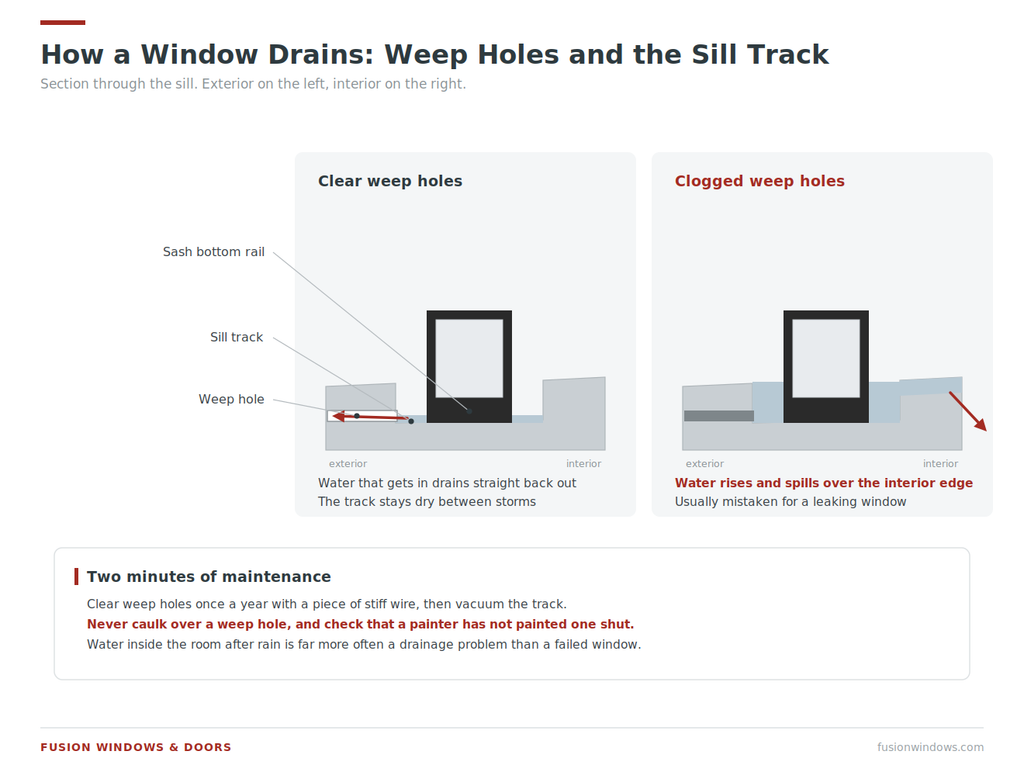
Clearing them takes a piece of wire and two minutes. This is the highest-value window maintenance task nobody performs. Never caulk over a weep hole, and check that a painter hasn’t.
Sill Pan and Flashing
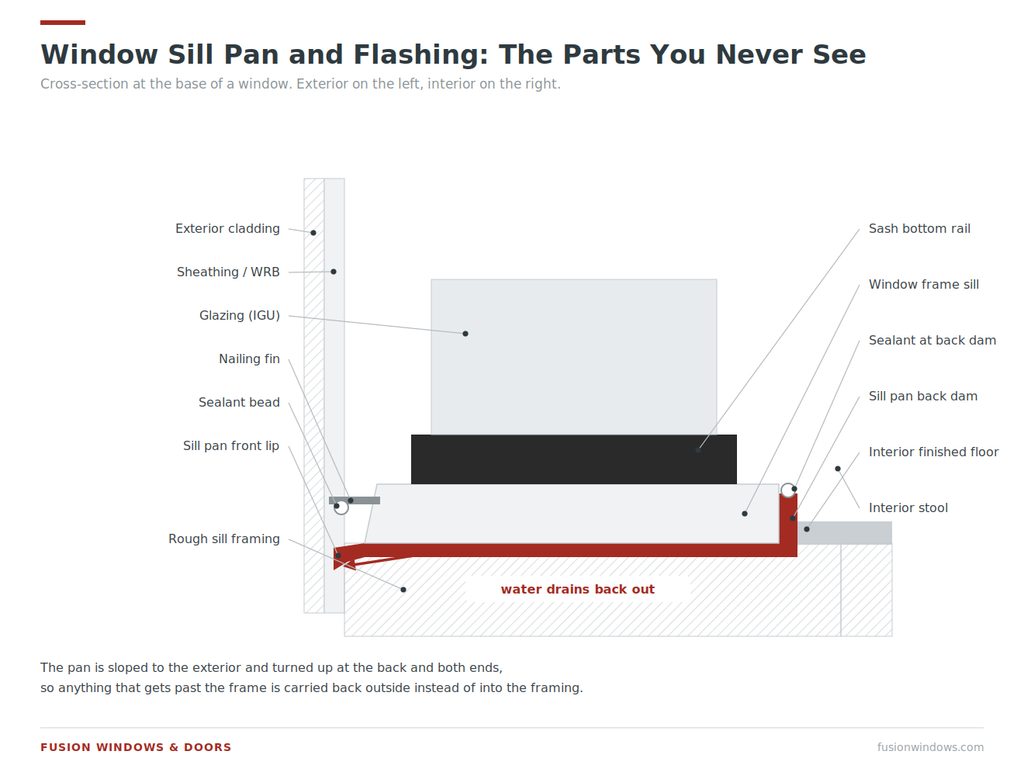
A sill pan is a waterproof tray under the window that catches anything getting past the frame and drains it back outside. Flashing does the same job at the head and jambs, lapped so water always flows outward and downward.
Neither is visible after installation, which is exactly why they get skipped. This is the most consequential part of a window that no homeowner ever asks about. When a window installation leads to rot, stucco staining, or a soft spot in the drywall below the sill, an absent or reverse-lapped flashing detail is nearly always the cause. Ask your installer to describe their flashing sequence before work starts, because you cannot inspect it afterward. Our installation team uses a pan and flashing sequence on every exterior opening as standard, not as an upgrade line item.
Drip Cap (Head Flashing)
Formed metal or vinyl above the exterior trim that pushes water out and away from the top of the window. Standard on a correctly detailed opening, missing on a surprising number of them.
Sealant
The exterior joint between the window frame and the wall cladding. It’s a secondary defense, not the primary one. If sealant is the only thing keeping water out of your wall, the installation was wrong. Sealant has a service life of roughly 10 to 20 years and should be inspected, not trusted indefinitely.
Trim and Exterior Components
Brickmould
Exterior casing that covers the gap between the frame and the wall cladding. Traditionally a profiled wood molding, now more often extruded vinyl or aluminum. Often factory-applied.
Interior Casing
The trim on the inside covering the gap between the jamb or jamb extension and the drywall. Installed on site by a finish carpenter. Along with the stool and apron, this is what makes a window look finished, and it’s the part most likely to be undersized on a builder-grade install.
Cladding
An exterior skin, almost always extruded aluminum, over a wood window’s frame and sash. It gives you wood’s stability and warmth on the inside with a durable, low-maintenance, factory-finished exterior. Nearly every premium wood window sold today is clad, including most of what Marvin and Andersen offer.
If you’re deciding between materials rather than brands, our comparison of fiberglass and vinyl windows covers the tradeoffs that matter in a hot, sunny climate.
Parts by Window Type
Different windows share most of the same vocabulary but not all of the hardware.
| Window type | Sash arrangement | Distinct parts |
| Double hung | Two vertically sliding sashes | Balances, check rail, cam lock, tilt pins |
| Single hung | Fixed top, sliding bottom | Balances on lower sash only, check rail |
| Casement | One side-hinged sash | Operator, operating arm, hinge track, multipoint lock |
| Awning | Top-hinged sash | Operator, arm, top hinge track |
| Hopper | Bottom-hinged, swings in | Bottom hinges, latch at head |
| Slider | Horizontally sliding sash | Rollers, sill track, head track, keeper |
| Picture | Fixed, often direct glaze | No operating hardware at all |
| Bay | Multiple units at angles | Head board, seat board, support brackets |
| Transom | Fixed or awning, above another unit | Mulled to the unit below |
| Bifold / pass-through | Folding panels | Carriers, hinges, top track, flush sill |
Operation Codes and Handing
Manufacturers describe how a window operates with letter codes, always read from the exterior looking in.
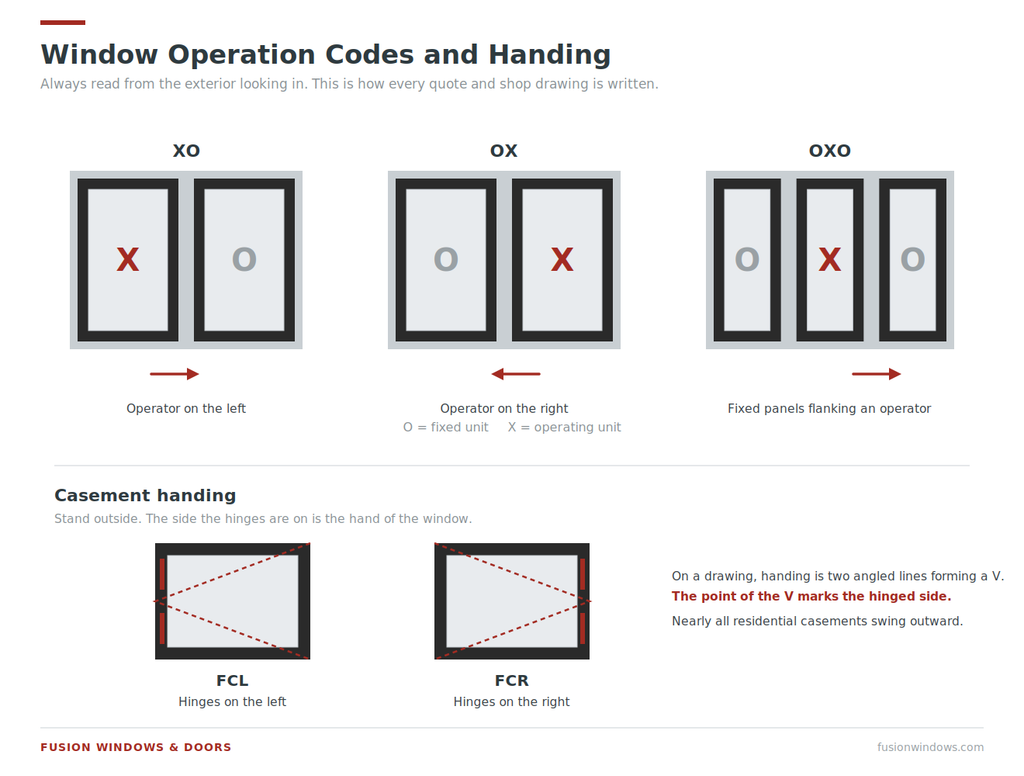
O means a fixed unit. X means an operating one. So an XO slider has the operating panel on the left as viewed from outside. An OXO is a fixed panel on each side of a center operator. This shows up on every quote and every shop drawing, and getting it backwards means your slider opens on the wrong side of the room.
For casements, handing describes which side the hinges are on. FCL (from the curb left) has hinges on the left when you’re standing outside. FCR has them on the right. On drawings, handing is shown with two angled lines forming a V, and the point of the V marks the hinged side.
Nearly all casements in residential work swing outward. Inswing casements exist, mostly on European systems, but they conflict with interior window treatments and are uncommon here.
Which Window Part Is Failing?
Working backward from the symptom:
| What the window is doing | Likely cause | Typical fix |
| Sash won’t stay up, slides down on its own | Failed or unbalanced sash balance | Replace balance, usually a repair not a replacement |
| Fog or haze between the panes | Failed IGU seal | Replace the glass unit, keep the frame and sash |
| Moisture on the room-side glass surface | Indoor humidity, not a window defect | Ventilation and humidity control |
| Draft around the perimeter when closed | Compressed or torn weatherstripping | Replace weatherstripping, low cost |
| Whistling at the middle joint on a hung window | Check rail seal or lock not drawing tight | Adjust or replace the cam lock and keeper |
| Water pooling in the sill or slider track | Clogged weep holes | Clear weeps with a wire, vacuum the track |
| Water or staining on the wall below the sill | Failed sill pan or reverse-lapped flashing | Open the exterior and re-flash, not a caulk fix |
| Crank is stiff or spins without moving the sash | Worn operator gearbox or dirty arm track | Clean and lubricate, or replace the operator |
| Casement won’t seal at top or bottom corner | Sash sag, or single-point lock on a tall sash | Adjust hinges, or upgrade to multipoint |
| Slider is heavy or grinds | Worn or seized rollers | Replace rollers before the track is damaged |
| Window won’t lock, lock misaligned with keeper | Frame racked out of square | Re-shim the frame, or reposition the keeper |
| Chalky, faded, or brittle vinyl frame | UV degradation | Replacement, this isn’t repairable |
| Rattles in wind | Loose lock or worn weatherstrip | Adjust the lock, replace the seal |
Two of these deserve a note.
Fog between the panes and condensation on the room-side glass look similar and mean completely different things. Fog inside the sealed unit means the IGU is done. Water on the interior surface of the glass usually means the air in your house is holding more moisture than the glass temperature can support, which is a ventilation problem. Our article on window condensation walks through how to tell them apart and what each one damages.
Vinyl frame degradation is the one item on this chart with no repair. Once a vinyl frame has chalked, warped, or gone brittle from UV, the material itself has changed. In sun-heavy parts of Los Angeles, cheaper vinyl on a south or west elevation can reach that point well before the glass does. If several windows on one elevation are showing it, that’s usually the moment to look at when to replace windows rather than repairing one at a time.
Frequently Asked Questions
What is the bottom part of a window called?
There are three, and they’re different. The sill is the sloped exterior bottom member of the frame. The stool is the flat interior ledge. The apron is the trim beneath the stool. Only the sill is part of the window itself.
What is the difference between a sash and a frame?
The frame is the fixed part that sits in the wall. The sash is the assembly holding the glass that sits inside the frame. On operating windows the sash moves and the frame doesn’t.
What is the bar in the middle of a double hung window called?
The check rail, sometimes called the meeting rail. It’s where the two sashes overlap, and it carries the lock and the weatherstripping for that joint.
What is the piece between two windows called?
A mullion, which is the seam where two window units are joined into a single assembly. Bars that divide a single pane into a grid pattern are muntins, grilles, or SDLs depending on how they’re built.
What are the little holes in the bottom of my window frame?
Weep holes. They let water that gets into the frame drain back outside. If they’re blocked, water backs up and spills inward during rain. Clear them with a wire and never caulk over them.
Can I replace just the glass instead of the whole window?
Often, yes. If the IGU seal has failed but the frame, sash, and hardware are sound, replacing the glass unit alone is a real option and costs a fraction of a full replacement. It stops making sense when the frame is degraded, the hardware is failing, or several windows are affected at once.
What parts of a window wear out first?
Weatherstripping and moving hardware, by a wide margin. Balances on hung windows, operators on casements, and rollers on sliders all wear before anything structural. Glass seals come next at 15 to 25 years. Frames, correctly installed and flashed, outlast all of it.
What is a nailing fin and does my window need one?
A flange around the frame perimeter that fastens the window to the wall sheathing and integrates with the flashing. New construction windows have them. Retrofit and block frame windows don’t, which lets them install into an existing frame without disturbing stucco or siding. Which one you need depends on whether the existing frame is sound.
Do more window parts mean better performance?
No. A picture window with no operating hardware at all is typically the best-performing window in a house, because there’s no moving joint to leak through. Every operating part is a place where air and water can eventually get in. That’s a reason to put fixed glass where you don’t need ventilation, not a reason to avoid operating windows.
Getting the Details Right
Knowing the parts is useful for two things: reading a quote without guessing, and telling a contractor what your window is actually doing instead of describing the symptom and hoping.
The parts that determine whether a window lasts are the ones you’ll never see once the trim goes on. Flashing laps, sill pans, shims behind the jambs, and whether the frame went in square. No amount of good glass compensates for getting those wrong, and no warranty covers them, because installation errors aren’t manufacturing defects.
Fusion Windows & Doors has been installing and replacing windows across Los Angeles since 2009, using in-house licensed installers rather than subcontractors. We carry Milgard, Andersen, Marvin, Fleetwood, Euroline, Windsor, and other manufacturers, and we install everything we sell across Pasadena, Malibu, the Palisades, Santa Clarita, and the surrounding areas.
If a window in your home is doing something on the chart above, or you’re planning a replacement and want someone to look at the opening before you order, get a free in-home estimate or call our Burbank showroom at (818) 245-8484.